
What is Cognitive-Behaviour Therapy (CBT)?
CBT is a type of psychological treatment that helps you to understand the links between what you think (cognitions), how you feel (emotions), your bodily reactions (physical symptoms), and what you do (behaviour). It is based on the theory that your interpretation of a situation, and not the situation itself, influences your emotional, behavioural, and physical reactions.



For example:
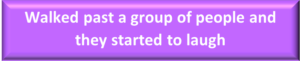
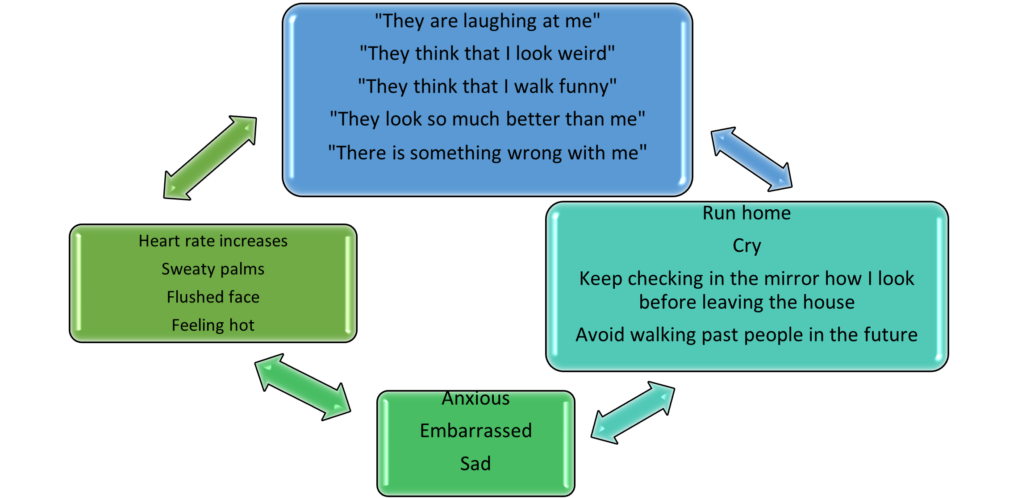
If your interpretations are distorted and unhelpful, they can contribute to emotional distress and behavioural problems. Sometimes, a vicious cycle is subsequently formed: An unhelpful reaction (emotional/physical/behavioural) can trigger even more distressing thoughts, which in turn increases the intensity/duration of the negative reaction – causing you to get stuck in a self-maintaining negative loop.
The GOOD NEWS is that all these areas are linked to each other, so making changes in one area can produce changes in the others.
CBT can help you break this cycle through either changing your distressing thoughts and/or unhelpful behaviours.
| CBT is: | |
| Collaborative | You and the therapist work together as a team – you both agree on what will be discussed in each session, the goals for therapy, and what self-help homework should be done |
| Structured | You and the therapist strive to adhere to a set structure in all sessions (see “How does a typical CBT session look like?”). In this way, the therapy process can be done most efficiently. |
| Educative, Includes self-help homework | It teaches you to be your own therapist by applying the skills you learnt in session to real life settings. |
| Present-orientated | Although your past and origin of problems aren’t ignored, CBT rather aims to solve problems by focusing on your current thinking and behaviour. In certain cases, however, more emphasis would be given to childhood origins of beliefs and behaviours. |
| Time-limited | Treatment generally ranges from 5- 20 sessions. However, the number and frequency of sessions will depend on your unique case. |
| Goal-orientated | You will set specific goals you would like to achieve in therapy. You and the therapist will also address any obstacles that prevent you from reaching these goals. |
How does a typical CBT session look like?
CBT sessions can be done either on an outpatient- or inpatient basis. A course of CBT usually takes between 5 – 20 sessions, with each session lasting about 45 – 60 mins.
After an initial intake evaluation (i.e., diagnostic examination), sessions generally follow the same format. This includes reviewing your mood, physical symptoms, and current problems; reflecting on what was discussed in the previous session; discussing items on the current agenda; reviewing therapy homework (if applicable); setting new homework (if applicable); summarizing and exchanging feedback. Your therapist will also provide information regarding the CBT model and your diagnosis (if applicable), listen to your expectations for therapy, and assist in developing a list of goals.
Towards the end of treatment, the possibility of future relapse is discussed. You will be encouraged to identify personal warning signs and implement a relapse prevention plan (which usually includes the skills you learned during therapy).
What techniques are used in CBT?
CBT doesn’t refer to one specific type of intervention. Instead, it uses a variety of techniques to change thinking, mood, and behaviour. The specific combination of techniques will depend on your case formulation and the objectives of a session. Regardless of the type of intervention selected, they all aim to change how you feel by changing what you think (cognitive) and changing what you do (behaviour).
Cognitive techniques:
These techniques will assist you to (1) become more aware of your thoughts; (2) explore their impact on your functioning; (3) evaluate the accuracy/usefulness of these thoughts; and (4) replace inaccurate/unhelpful thoughts with more accurate/helpful patterns.
The purpose of these techniques is not to “think happy thoughts.” The therapist will also not challenge your perspective, nor does he aim to persuade you to take on his own viewpoint. Instead, the goal is to produce a more adaptive, balanced, and realistic version of the original thought.
Examples of techniques:
- Socratic questioning techniques (e.g., Looking for evidence for and against the thought)
- Keeping a thought diary
- Imagery
Behavioural techniques:
Some of the most powerful CBT interventions involve you doing something, such as conducting a behavioural experiment to test out the validity of your beliefs or confronting situations that scares you. You and the therapist will carefully design and agree upon such interventions. Positive changes in behaviour can consequently have effects on your thoughts, emotions, physical symptoms, and future behaviour.
Examples of techniques:
- Goal setting
- Relaxation exercises
- Increasing pleasurable and productive activities
- Social skills training
- Assertiveness training
- Role-playing
- Problem solving
- Exposure therapy
- Behavioural experiments
Other techniques:
CBT is ever evolving. Over the years, additional or specialized forms of CBT have been developed. Examples include dialectical behaviour therapy (DBT), mindfulness-based cognitive therapy (MBCT), CBT for insomnia (CBT-I), trauma focused CBT (TF-CBT), acceptance and commitment therapy (ACT), and schema therapy. These approaches incorporate additional techniques such as mindfulness, emotional regulation, compassion focused techniques, and/or acceptance skills. Some approaches are even tailored for a specific problem/diagnosis.
So, modern CBT is a “family” of therapies that combine various cognitive, behavioural, and emotion-focused strategies.
Who can benefit from CBT? Is it effective?
CBT is probably the most popular psychotherapy in the world. It is appropriate for all age groups, from young children to the elderly. It can be used in individual treatment or with groups, couples, and families. It is appropriate to use across a range of problem severity; from mild symptoms to more complex cases.
It is also very well supported by decades of research; so, it has been included in international guidelines for treating a variety of disorders. CBT can be used to treat many different types of psychiatric conditions, such as depression, bipolar disorder, anxiety disorders, obsessive compulsive disorder (OCD), post-traumatic stress disorder (PTSD), phobias, panic disorders, substance abuse, psychotic disorders, eating disorders, and insomnia. It can also be used for subclinical problems such as stress management, anger management, and low self-esteem.
CBT can also be used as an adjunctive treatment in physical illness. It can help you cope with any distress associated with the medical condition; assist you in making the necessary adjustments in response to the illness; improve treatment adherence and quality of life; and/or reduce the intensity/impact/frequency of some symptoms (e.g., pain, fatigue). Various studies have found support for the effectiveness of CBT interventions for coping with illnesses involving chronic pain (e.g., migraine headaches, chronic low back pain, fibromyalgia, rheumatoid arthritis), sickle cell disease, diabetes, and irritable bowel syndrome; to name a few.
Is CBT right for me?
CBT has proven to be effective for many people suffering from a wide range of problems. However, it might not necessarily work for everyone. During the initial phase of therapy, you might find it uncomfortable or stressful to become aware and confront distressing thoughts or behaviours. CBT also requires motivation and commitment to complete homework tasks between sessions. In addition, it requires active participation from both you and the therapist. As with other psychotherapies, you might not see substantial change immediately. Instead, it takes some time for newly learned skills to be practised and form part of your daily life.
If, for whatever reason, CBT is not appropriate, then there are other types of psychotherapies that are also effective. Alternatively, strategies from different therapeutic approaches could complement each other and be integrated into your unique treatment plan. In other words, the therapist “borrows” techniques from different types of psychotherapies to generate a treatment plan best suited to your needs and style (This is called an integrative/eclectic approach to therapy).
In some cases, using either medication or psychotherapy will be equally effective. In other instances, the use of one treatment could prove superior over the other. Still, many cases suggest that the combination of psychotherapy and medication will be more beneficial than either treatment alone. Ultimately, you and your therapist/doctor will explore which type of treatment (psychotherapy, medication, or both) will be best suited for your unique case. If psychotherapy is recommended, then you and your therapist will also discuss which type of psychotherapy (e.g., CBT) would be most appropriate.
References and further information
Books and websites:
Beck Institute Cognitive Behavior Therapy. https://beckinstitute.org/
Beck, J. S. (1995). Cognitive therapy: Basics and beyond. New York, NY: The Guilford Press.
Sharf, R. S. (2008). Theories of psychotherapy and counselling. Concepts and cases. (4th edition). Belmont, CA: Brooks/Cole, Cengage Learning.
Journal articles:
Andreae, S. J., Andreae, L. J., Richman, J. S., Cherrington, A. L., & Safford, M. M. (2020). Peer-delivered cognitive behavioral training to improve functioning in patients with diabetes: A cluster-randomized trial. The Annals of Family Medicine, 18(1), 15-23.
Bae, J. Y., Sung, H. K., Kwon, N. Y., Go, H. Y., Kim, T. J., Shin, S. M., & Lee, S. (2021). Cognitive Behavioral Therapy for Migraine Headache: A Systematic Review and Meta-Analysis. Medicina, 58(1), 44.
Barth, J., Munder, T., Gerger, H., Nüesch,E., Trelle, S., Znoj, H., Jüni, P., & Cuijpers, P. (2016). Comparative efficacy of seven psychotherapeutic Interventions for patients with depression: A network meta-analysis. Focus, 14, 229 – 243.
Beck, J. S., & Fleming, S. (2021). A Brief History of Aaron T. Beck, MD, and Cognitive Behavior Therapy. Clinical Psychology in Europe, 3(2), 1-7.
de Roos, C., Rommelse, N., Donders, R., Knipschild, R., Bicanic, I., & de Jongh, A. (2020). Response to “Comparing the Effectiveness of EMDR and TF-CBT for children and adolescents: A meta-analysis. Journal of Child & Adolescent Trauma, 13, 89–91.
Fenn, K., & Byrne, M. (2013). The key principles of cognitive behavioural therapy. InnovAiT, 6(9), 579-585.
Gautam, M., Tripathi, A., Deshmukh, D., Gaur, M. (2020). Cognitive behavioral therapy for depression. Indian Journal of Psychiatry, 62, S223 – S229.
Halford, J., & Brown, T. (2009). Cognitive–behavioural therapy as an adjunctive treatment in chronic physical illness. Advances in Psychiatric Treatment, 15(4), 306-317. doi:10.1192/apt.bp.107.003731
Haverkampf, C. J. (2017). CBT and psychodynamic psychotherapy – A comparison. Journal of Psychiatry Psychotherapy and Communication, 6(4), 61-67.
Hofmann, S. G., Asnaani, A., Vonk, I. J .J., Sawyer, A. T., & Fang, A. (2012). The efficacy of cognitive behavioral therapy: A review of meta-analyses. Cognitive Therapy and Research, 36, 427–440.
Hongguang C., He, Q., Wang, M., Wang, X., Pu, C., Li, S., & Li, M. (2022). Effectiveness of CBT and its modifications for prevention of relapse/recurrence in depression: A systematic review and meta-analysis of randomized controlled trials. Journal of Affective Disorders, 319, 469-481.
Kinsinger S. W. (2017). Cognitive-behavioral therapy for patients with irritable bowel syndrome: current insights. Psychology research and behavior management, 10, 231–237.
Lamb S., E, Hansen Z., Lall R., Castelnuovo E., Withers E., J., Nichols V., Potter R., & Underwood M., R. (2010). Group cognitive behavioural treatment for low-back pain in primary care: a randomised controlled trial and cost-effectiveness analysis. Lancet, 375, 916-923.
Lewey, J.H., Smith, C.L., Burcham, B. et al. Comparing the Effectiveness of EMDR and TF-CBT for Children and Adolescents: A meta-analysis. Journal Child & Adolescent Trauma, 11, 457–472 (2018).
Mitchell, M. D., Gehrman, P., Perlis, M., & Umscheid, C. A. (2012). Comparative effectiveness of cognitive behavioral therapy for insomnia: a systematic review. BMC Family Practice, 13(40), 1 -11.
Oud, M., De Winter, L., Vermeulen-Smit, E., Bodden, D., Nauta, M., Stone, L., . . . Stikkelbroek, Y. (2019). Effectiveness of CBT for children and adolescents with depression: A systematic review and meta-regression analysis. European Psychiatry, 57, 33-45.
Papola, D., Ostuzzi, G., Tedeschi, F., Gastaldon, C., Purgato, M., Del Giovane, C., . . . Barbui, C. (2022). Comparative efficacy and acceptability of psychotherapies for panic disorder with or without agoraphobia: Systematic review and network meta-analysis of randomised controlled trials. The British Journal of Psychiatry, 221(3), 507-519.
Samaan, M., Diefenbacher, A., Schade, C., Dambacher, C., Pontow, I.- M., Pakenham, K., & Fydrich, T. (2021). A clinical effectiveness trial comparing ACT and CBT for inpatients with depressive and mixed mental disorders. Psychotherapy Research, 31(3), 355 – 3668.
Sigurvinsdóttir, A. L., Jensínudóttir, K. B., Baldvinsdóttir, K. D., Smárason, O., & Skarphedinsson, G. (2020). Effectiveness of cognitive behavioral therapy (CBT) for child and adolescent anxiety disorders across different CBT modalities and comparisons: A systematic review and meta-analysis. Nordic Journal of Psychiatry, 74(3), 168-180.
Thompson, R., D., Delaney, P., Flores, I., Szigethy, E. (2011). Cognitive-Behavioral Therapy for Children with Comorbid Physical Illness. Child and Adolescent Psychiatric Clinics of North America,20(2), 329-348.
